Case Study
Turning a technical compliance tool into a platform people actually trust.
Breakwater's data privacy platform is used by data governance and compliance teams across regulated industries — financial services, healthcare, and insurance — to find and mitigate sensitive data across their networks before it becomes a breach. It was built from a technical perspective first — with no clear path for the people who had to use it every day. I rebuilt the experience around real users, ran it through a research-driven roadmap, and partnered directly with the CPO to make design part of the business conversation, not an afterthought of it.
The Problem
Built for compliance. Not for the people who had to run it.
The ask: rebuild a user-centric data privacy service that's intuitive and covers the features the next version needed — while I also managed the designers keeping the current version running.
No experience flow
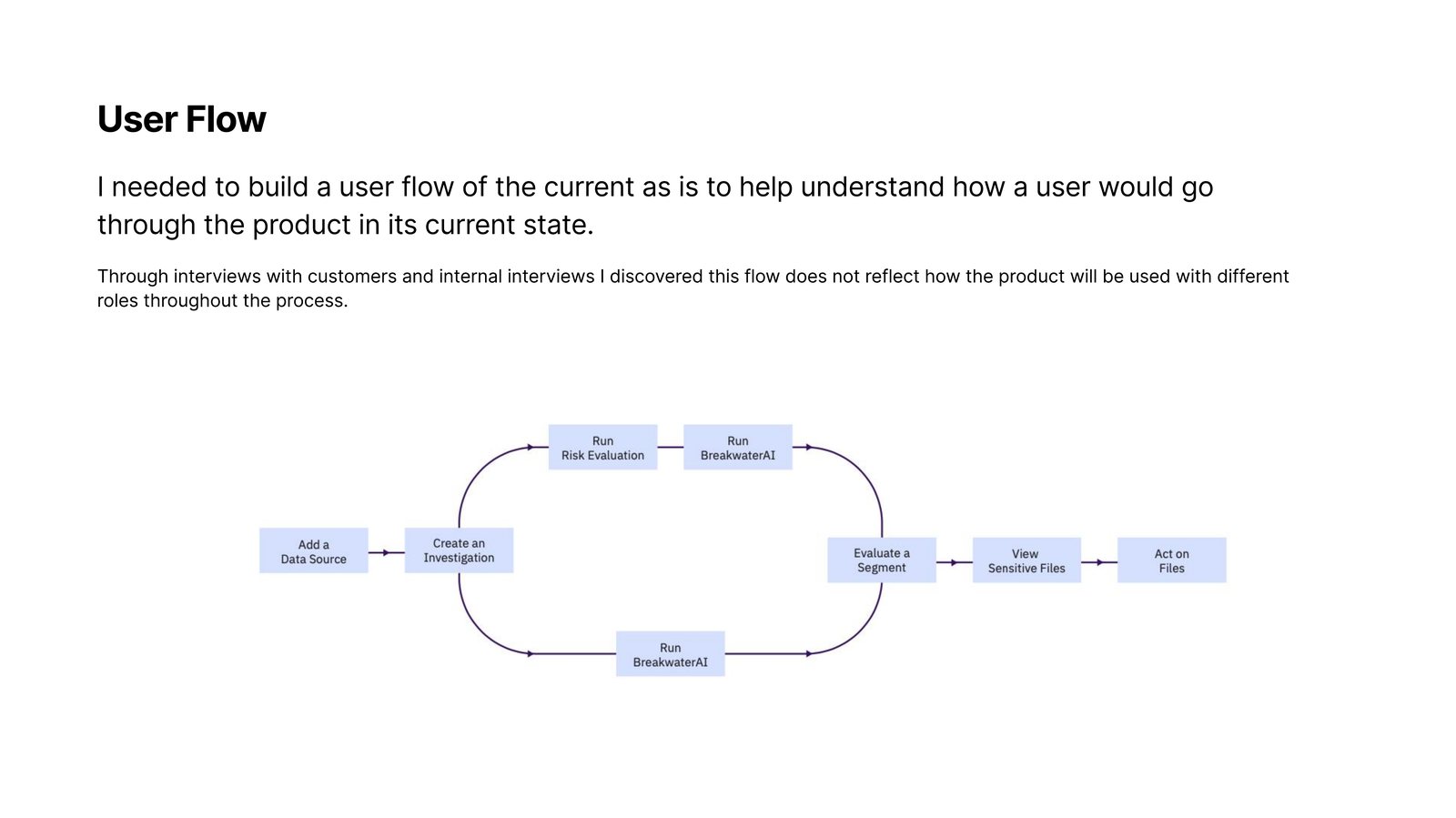
The product was built from a technical perspective first. There was no clear path for what users should do, or when — the experience was never considered.
Unclear users
We knew who the buyer was — but not who the day-to-day users actually were, or what they needed to get done.
Inconsistent patterns
A design system existed on paper, but was applied inconsistently — usage and patterns drifted from screen to screen.
My Role
Three hats, one connected effort.
Partner to Product & Engineering
Worked directly with Product and Engineering on the current framework, design effort, ways of working, and where design creates business value.
Hands-on research & workshops
Led research, ran workshops, and defined the new workflow for our customers — hands-on rather than delegated.
Coach to a team of three
Led a small team of three designers on their day-to-day delivery, future vision, and career development.
Process
Evaluate, understand, define, design.
Every step was led with either Product or Engineering as a partner — never design working in isolation.
Evaluation & recommendations
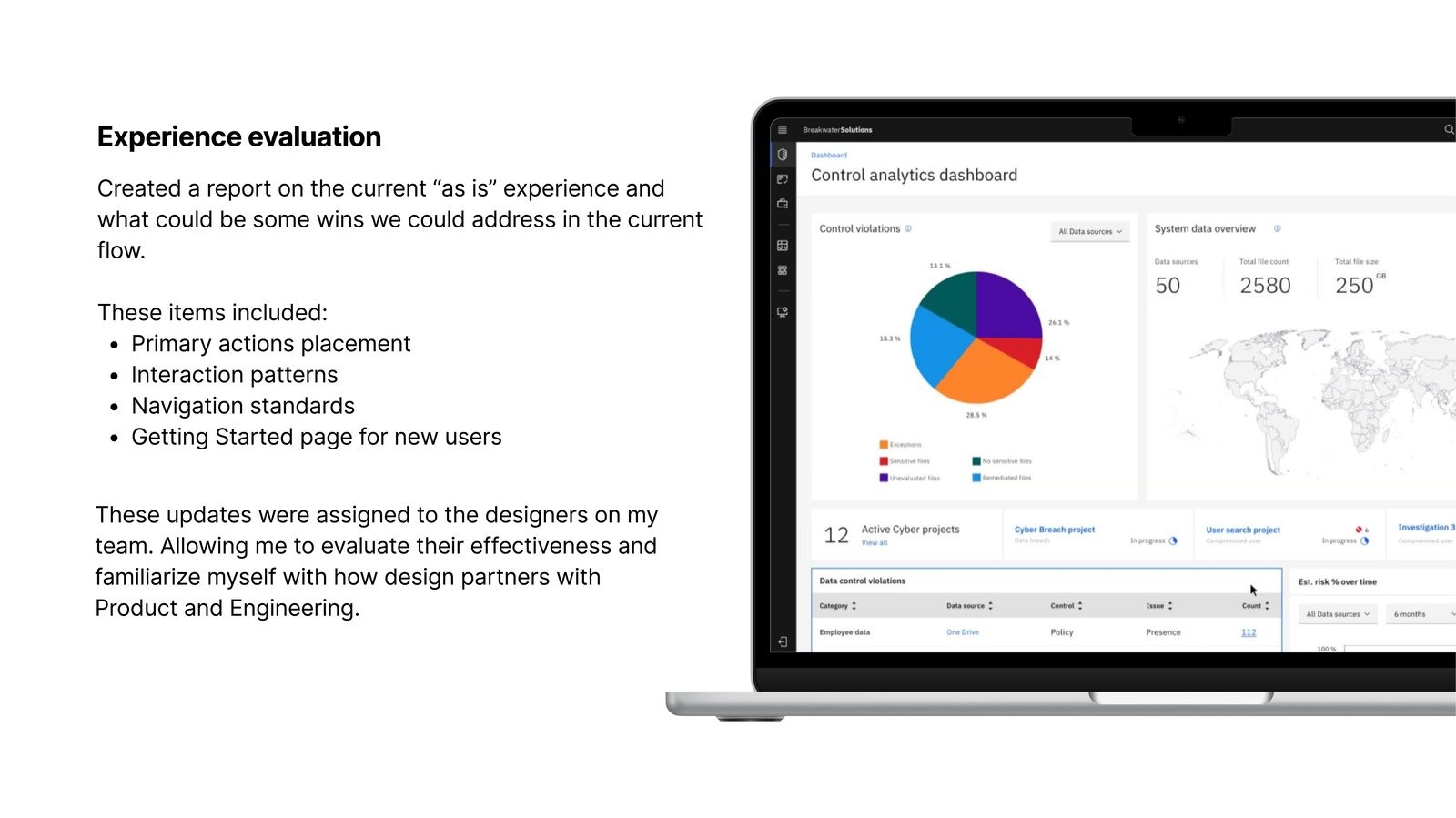
Evaluated the current experience to create quick wins that would immediately improve customer experience.
User research
Interviewed Data Governance Officers and Data Stewards on their expectations and day-to-day challenges.
Roadmap definition
Facilitated workshops with Product and Engineering on the 2.0 roadmap, weighing feature and user requirements.
Design solution
Designed a new product experience that guides users, covers required features, and holds together with consistency.
User Research
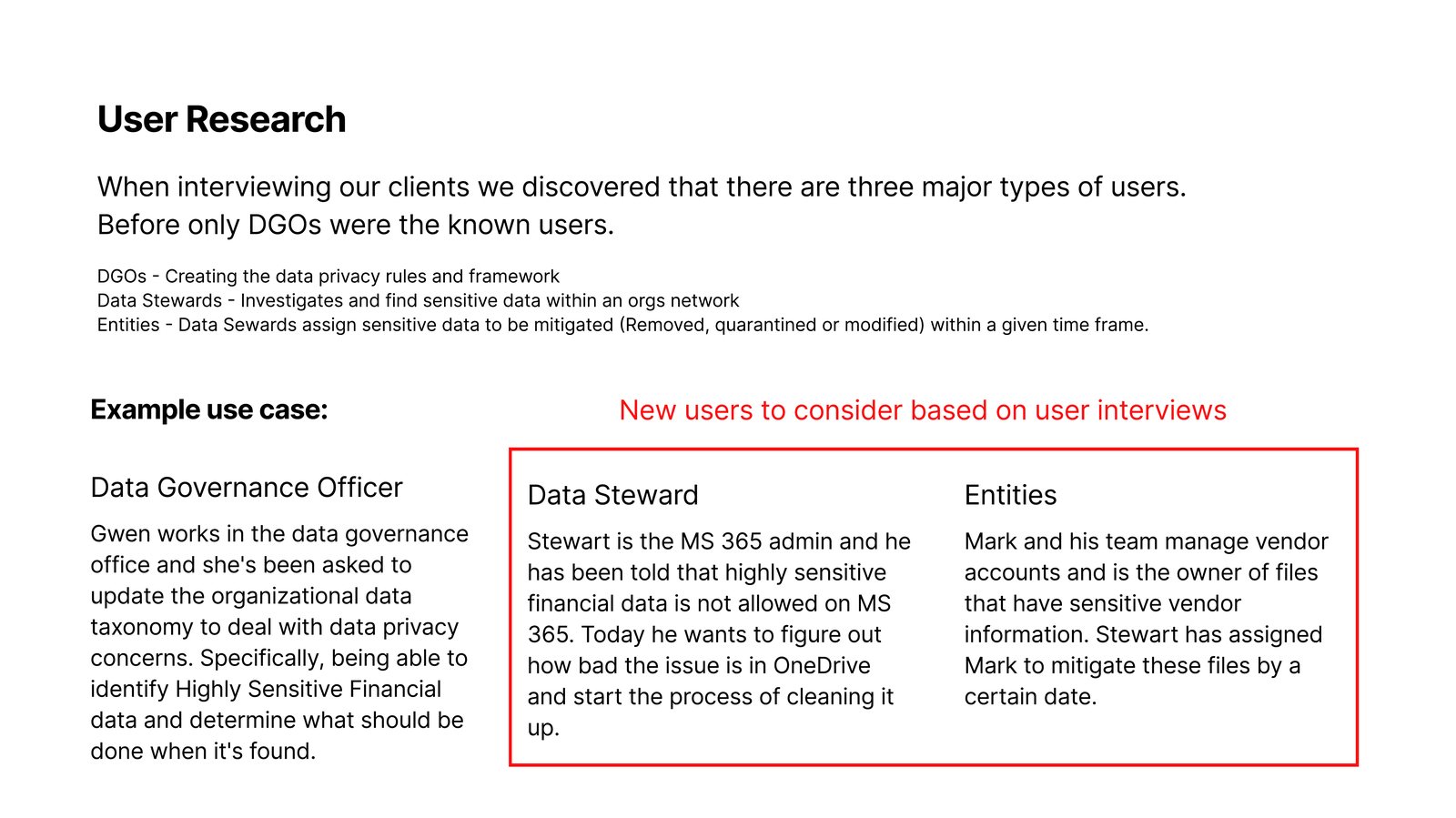
One assumed user. Three real ones.
Before this work, only Data Governance Officers were considered "the user." Interviews with customers surfaced two more roles the product needed to design for.
Data Governance Officer
Creates the data privacy rules and taxonomy. Gwen needs to identify highly sensitive financial data and decide what should happen when it's found.
Data Steward
Investigates and finds sensitive data across the org's network. Stewart, an MS 365 admin, needs to size up an issue in OneDrive and start cleaning it up.
Entities
Assigned sensitive data to mitigate — remove, quarantine, or modify — within a deadline. Mark's team owns files with sensitive vendor information.
The Workshop
A two-day reset with Design, Product & Engineering.
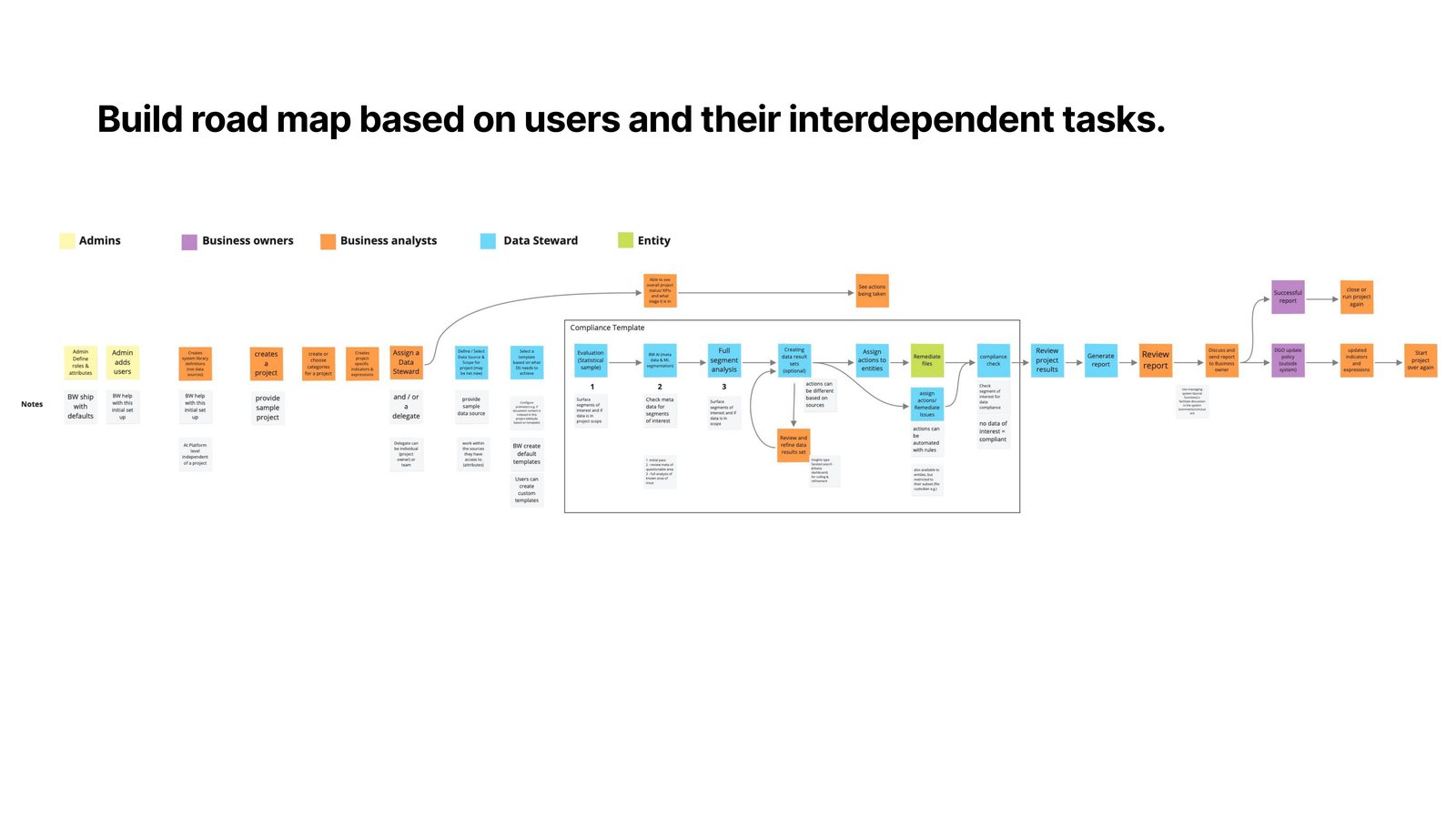
We ran a two-day workshop to clearly define and understand user actions, then built a roadmap based on users and their interdependent tasks.
What we learned: there were far more user types in the system than previously known, the product needed to scale its experience to customer size, and we now had a feasibility-to-value matrix to move forward with.
Outcomes: a prioritized new project-creation flow, a shared understanding of who our users are, a naming convention for them, clear goals per role, and defined next steps for the roadmap.
The Solution
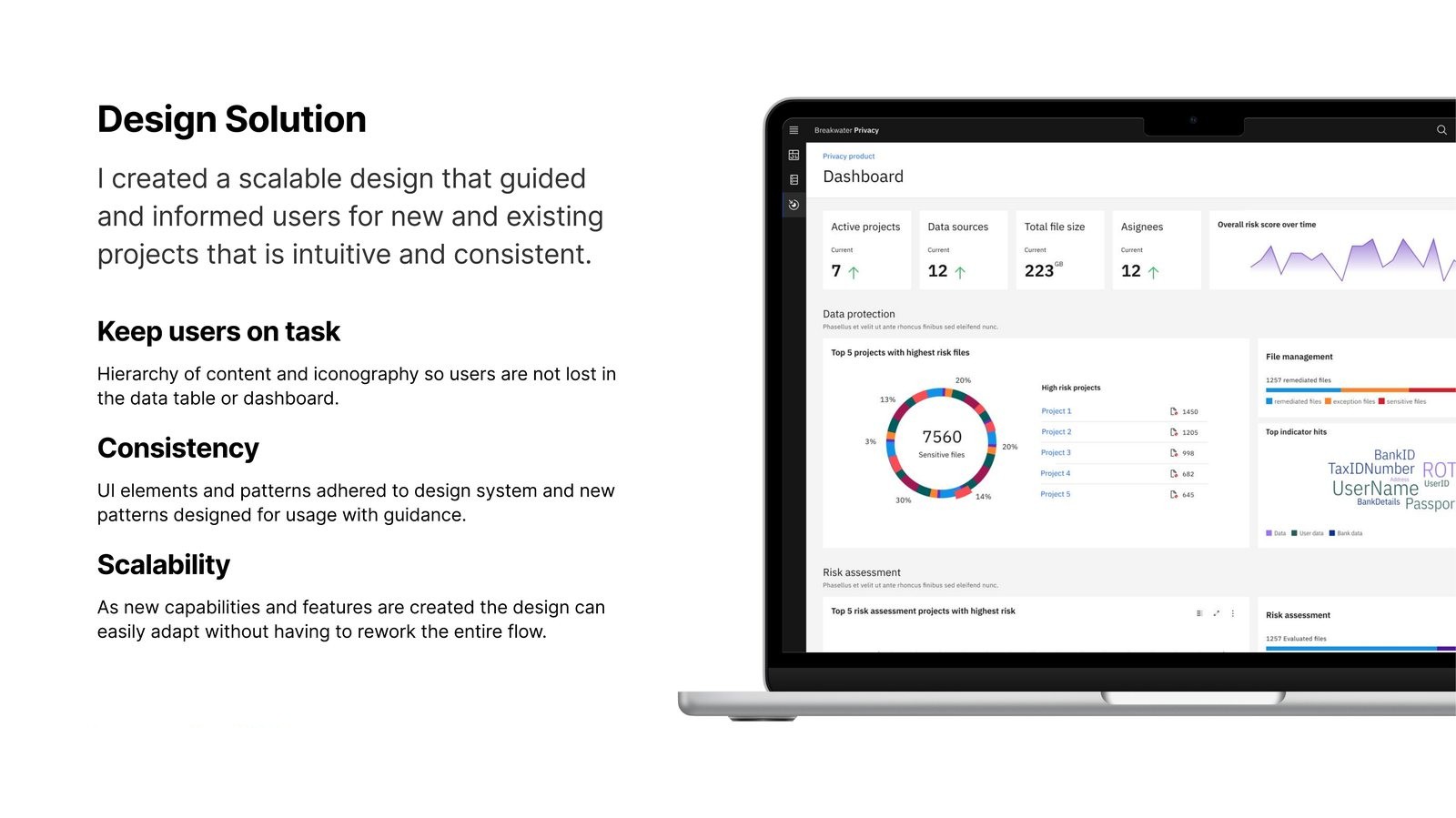
A scalable design that guides, not just displays.
Keep users on task
Hierarchy of content and iconography so users are never lost in the data table or dashboard.
Consistency
UI elements and patterns adhered to the design system, with new patterns designed for guided usage.
Scalability
As new capabilities and features arrived, the design could adapt without reworking the entire flow.
Feedback & Results
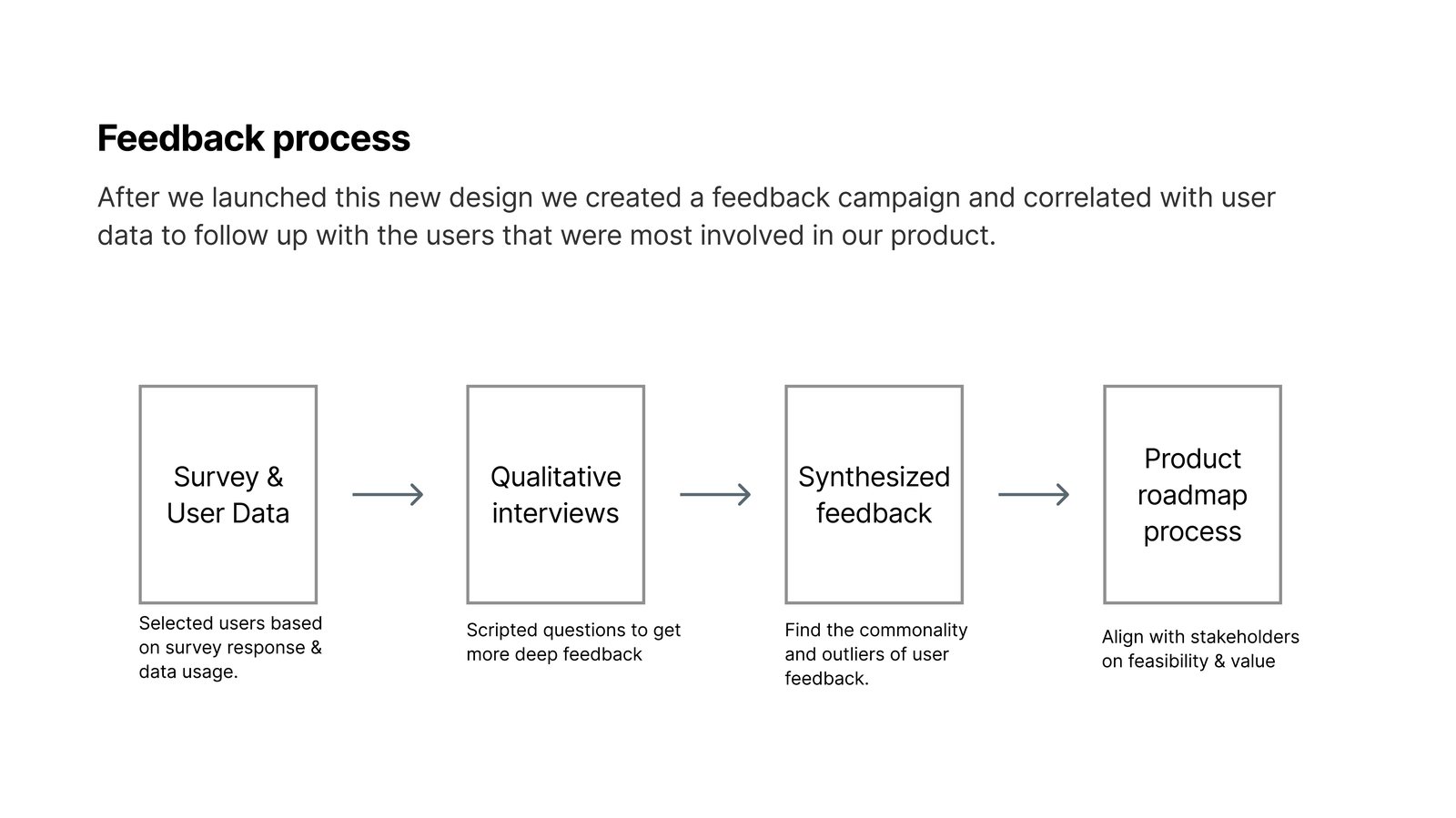
We launched, then closed the loop with data.
Survey & usage data → scripted qualitative interviews → synthesized feedback → aligned back into the product roadmap process with stakeholders. The redesign cut rework by an estimated 20% — reclaiming roughly a day per designer each sprint that had previously gone into revision cycles instead of new feature work, across the 3-person team.
New Users
Happy to see a clear, guided project-creation experience — though they wondered how the process could become more automated, and wanted a more personalized, customizable dashboard.
Existing Users
Needed a learning curve to adjust to the new system, but still preferred the guided experience and the new dashboard elements over the old design.
Opportunities Uncovered
- What automation and AI integration could be layered throughout the system.
- A customized dashboard tailored to each type of user.
- Supporting legacy users through the new workflow to reduce their learning curve.
Leading the Team
Coaching designers against their own goals — not just the roadmap.
My management style is a coach: supporting and challenging designers based on where their own career goals intersect with business objectives — through weekly 1:1s, design round tables, daily stand-ups, career check-ins, mentorship, and team culture events.
Be present, be accountable, be creative — and have joy in what you do.
My mantra for the team“Alex is a tremendous design leader — his understanding of the design process, desire for user feedback, and willingness to update designs led to an incredibly usable product experience.”
Will Jaibaji — Chief Product Officer, Breakwater Solutions