Case Study
Turning a feature-bloated storage service into IBM's highest-scoring Cloud product.
Cloud Object Storage (COS) is IBM's flexible storage service — users create buckets, add objects, and govern both with policies like retention and archiving. Those policies had grown into two inconsistent flows — creation and configuration — each surfacing different information through a maze of modals and conditional logic. I led the redesign into a single card-based pattern, backed by competitive research and customer interviews, that shipped back into IBM's Carbon Design System and drove an 82-point NPS swing in a year.
The Problem
Two flows, two designs, one confused user.
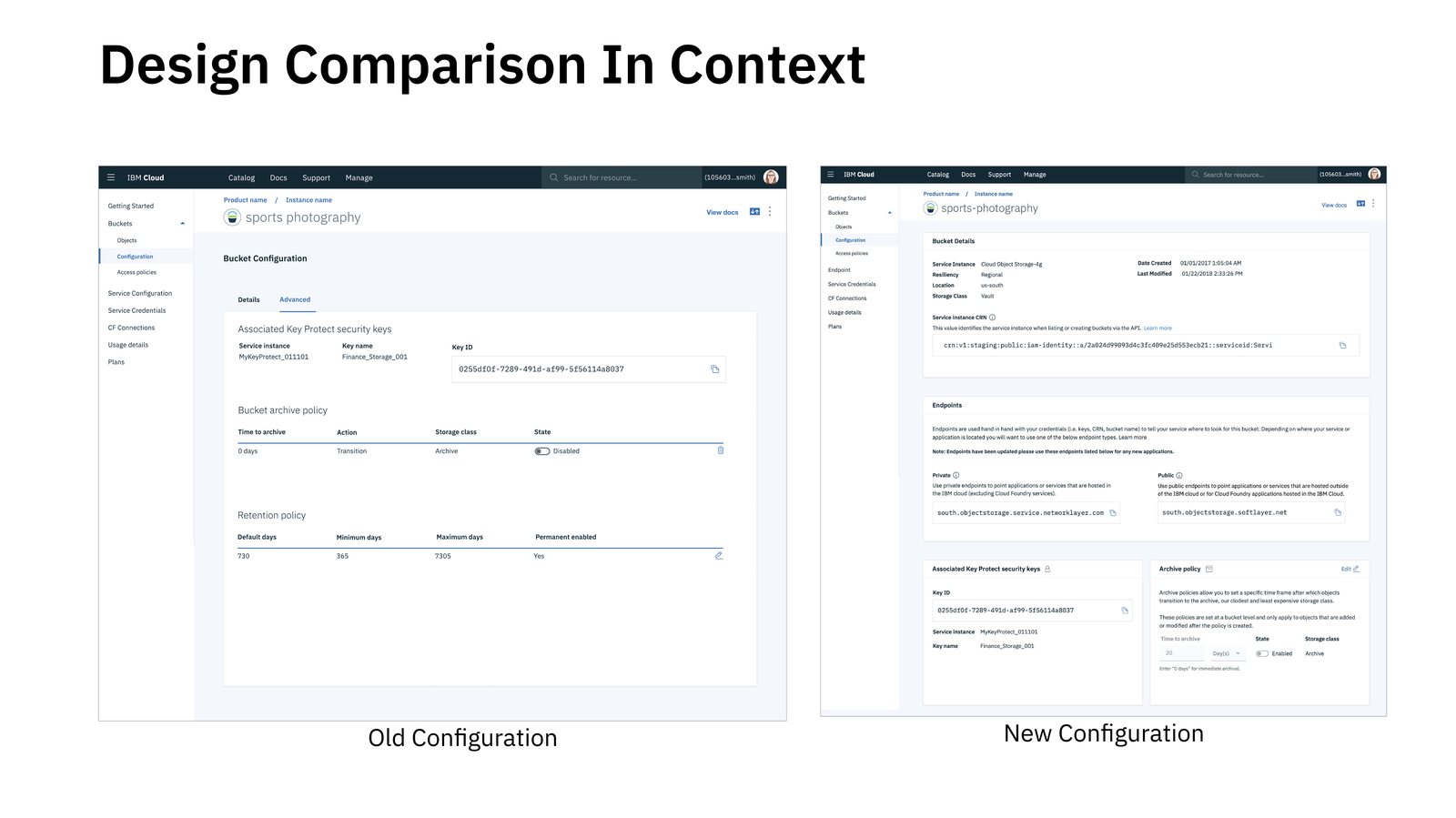
Bucket policies could be set at creation or in configuration — and the two had radically different designs, surfacing different information for the same underlying settings.

Scalability & consistency
Every new policy risked its own one-off design — nothing scaled, and nothing matched what shipped before it.
Design limitations
Modals were required to facilitate every policy change, leading to complex conditional logic and a design that fought its own constraints.
Competitive value
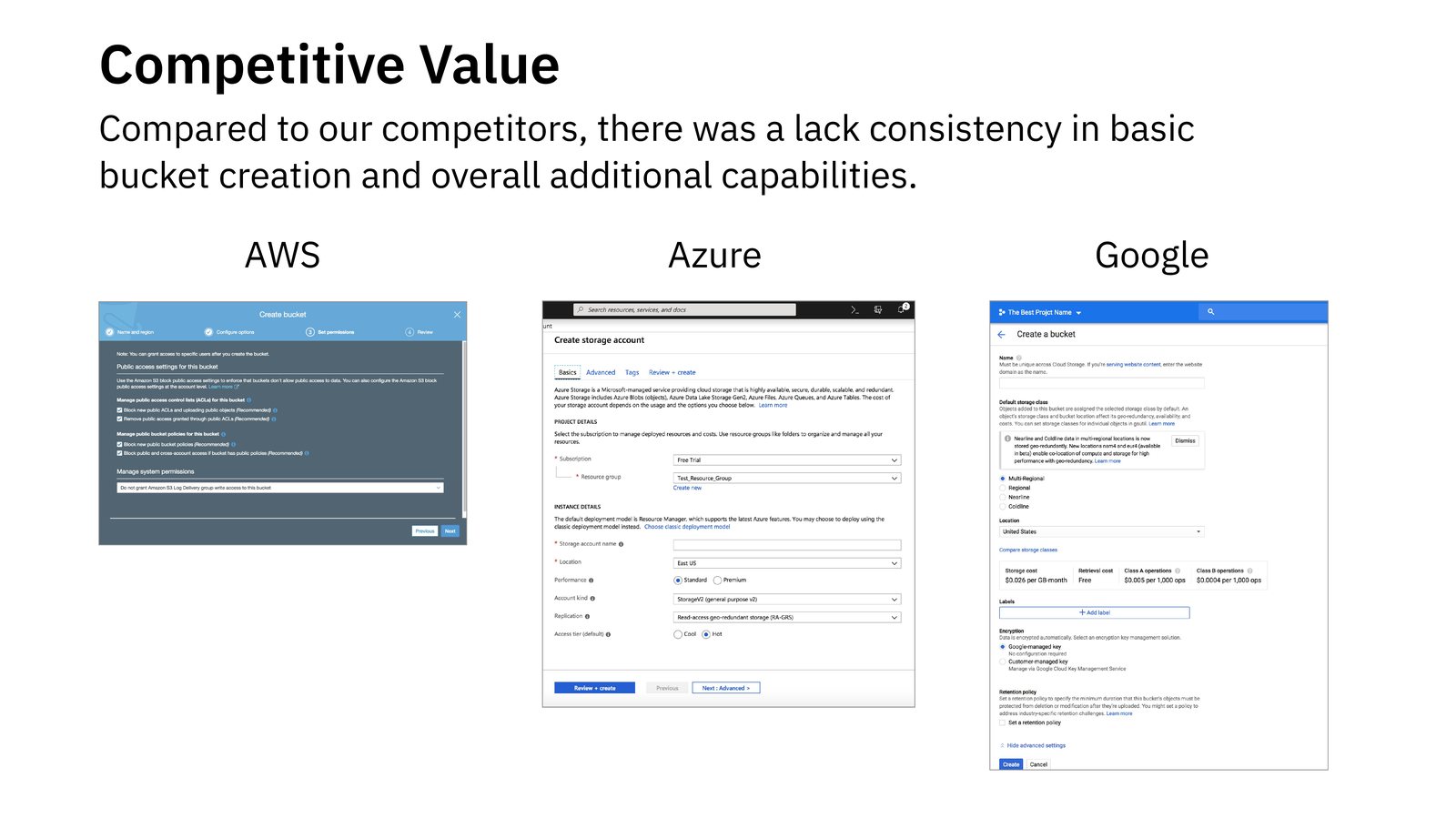
Compared to AWS, Azure, and Google, COS lacked consistency in basic bucket creation and in what capabilities it surfaced.
Usability Through User Research
Useful features, delivered in a confusing way.
Customers found real value in appending features during bucket creation — but the way it was built introduced friction of its own.
- Impeded the ease of use needed just to get started.
- Left customers unsure of the actual value of a given add-on service.
- Raised an unanswered question every time: is there an additional cost?
- Design and Development couldn't see what features were coming next, forcing flexible, one-off design work that cost time and resources anticipating future product needs.
Collaboration Process
From surfaced problem to pattern shipped back to Carbon.
A closed loop across Product Management, the Carbon Design System team, Design, and Engineering — so the fix wasn't a one-off, it became reusable.
Surface the problem
Product Management surfaces the UX issue and the need to find a solution.
Check Carbon first
Does an existing Carbon pattern already solve this? If not, Design proposes a concept for Carbon Team sign-off.
Design, test, align
Design creates the new pattern with UXR, syncing experience iteratively with Engineering on feasibility, time, and effort.
Ship & contribute back
Engineering code-reviews the build and validates it against IBM's internal Accessibility Checkpoint requirements — keyboard navigation, screen-reader labeling, and color contrast — before the pattern is contributed back to Carbon for every other product to reuse.
The Solution
A card system that surfaces value at a glance.
Every policy became a card with clear states — so its value and properties are visible whether or not it's enabled. Modals stayed, but only to validate a card's properties, not to carry the whole feature.

Contribution
A pattern other IBM teams still use today.
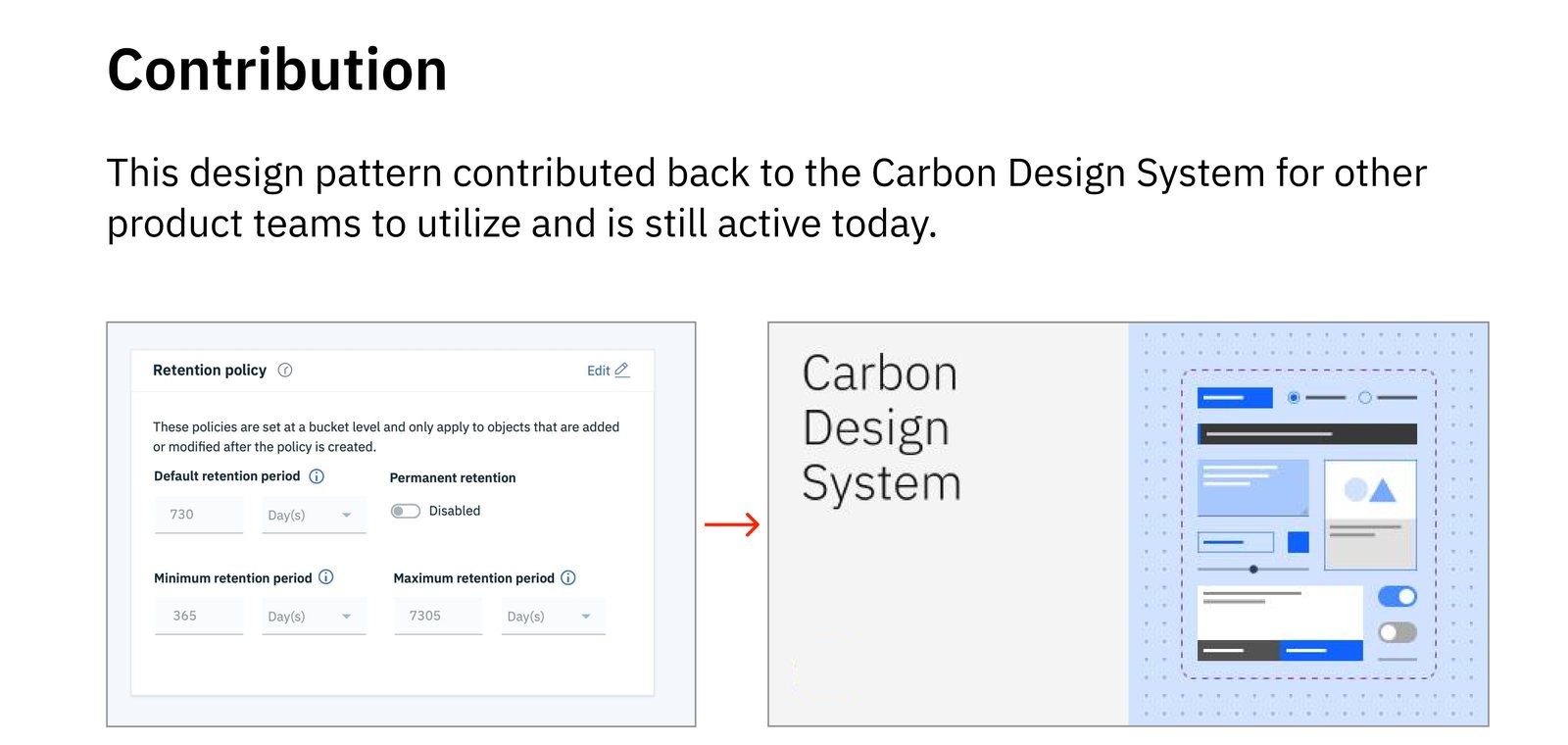
This design pattern was contributed back to the Carbon Design System for other product teams to adopt — and it's still active today.
Customer Feedback
What customers said, in their own words.
"I can see the properties of my policies more clearly now."
"It is far more clear what the value is of each policy even if I don't have it enabled."
"Before I was not quite sure what the repercussions were of enabling or disabling something. Now I can be confident in my process."
"Easier to code knowing we don't have to build one-off designs anymore."
Results
An 82-point NPS swing in a single year.
Adding the card pattern and removing clutter from bucket creation helped the service swing from a −55 to a +27 Medallia/NPS score — a +82-point upswing year over year.

Next Steps
From one fix to the next redesign.
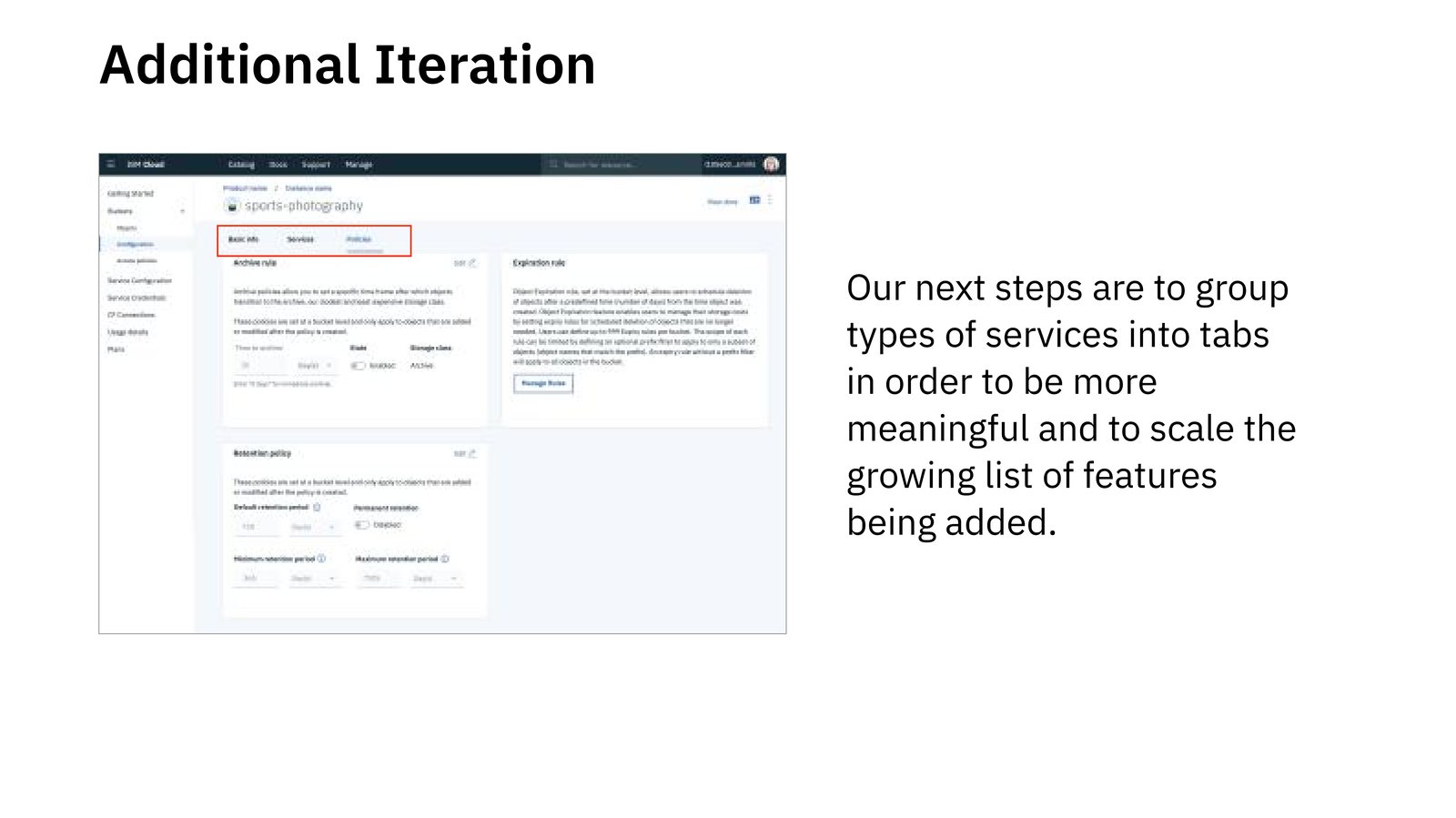
With NPS results and buy-in from Product and Engineering secured, the next step was grouping services into tabs to stay meaningful as the feature list kept growing — then carrying the same approach into Provisioning, Getting Started, and Bucket Creation.
"Alex dove in head first with no ego to transform the team from the inside using IBM Enterprise Design Thinking methodologies. He delivered on that promise within a few short months and really turned the team around."
Ty Tyner — Design Director, IBM